Public scholarship

Public Projects

I have created or co-created a range of popular online resources on the history of climate change.

The Climate Chronicles

Projects

Ongoing projects

01

Interactive website

After2C

Visit project

This interactive website answers a simple question: how will the history students of the future write about global warming in our century? After2C began as a project in “Existential Risk,” a Georgetown University undergraduate seminar that I designed and taught. The website begins with fictional history paper about a global catastrophe in 2046, brought on by a powerful El Niño. From there, it explores four plausible futures, some considerably more frightening than others.

Because these futures are presented as history papers, they can dive deeply into the complexities of climate adaptation, mitigation, and geoengineering – exploring tradeoffs, unintended consequences, and path dependencies.

Ultimately, After2C is not intended not just to provide a public resource, but also a model for the kinds of projects that can be pursued with university students who might be fearful or depressed about the future. Projects that motivate students by directly addressing real world problems: in this case, the challenge of educating the public about the potential futures of global warming.
Visit project
02

Podcast · Website · YouTube

The Climate Chronicles

Visit project

Climate change may seem like something totally new. And indeed, human-caused global warming has only heated the planet for about a century. Only in the last decade has it become a serious threat to humanity.

But climate change, defined as a long-term shift in weather, has always affected humanity. Natural climate changes were different from today’s global warming, but they did have an influence on history. The Climate Chronicles describes that influence, and explores what it can tell us about today’s climate crisis.

In 42 episodes spread across eight seasons, The Climate Chronicles draws on the latest scholarship in such fields as archaeology, history, climatology, and geology to present a comprehensive picture of how climate change has influenced humanity. It explains complicated concepts in plain language, in a vivid, narrative style. Every episode is a stand-alone story, and every season its own distinct chapter in climate’s history.

Winner of the 2025 European Society for Environmental History Bristol-Bern Prize in Public Environmental History, The Climate Chronicles is a one-of-a-kind resource. It’s a podcast, a website, and a YouTube channel with dramatic preview videos that make history come alive for students of all ages. It’s multimedia, multidisciplinary, and best of all: it’s free. Intended for anyone with an interest in climate change or the past, The Climate Chronicles will help you understand global warming in a whole new way.

Visit project
03

International research network

Climate History Network

Visit project

The Climate History Network (CHN) connects researchers who are interested in past climates, weather, and weather-related hazards and how they shaped human history. We currently have over 200 members, including historians, archaeologists, geographers, climate scientists, scholars of art and literature, and more. We regularly inform our members about new publications and opportunities, in order to promote the study of past climates around the world. We’ve also compiled a unique Zotero bibliography of publications in the field.

I founded the CHN with my colleague, Sam White, following discussions in 2010. The CHN is part of the International Congress of Environmental History Organizations. Our programs are made possible through financial support provided by Georgetown University and the Georgetown Earth Commons. Our email list is hosted by Ohio State University. We do not have any political affiliation, and membership is free.

The iceberg photograph was taken by CHN member Benoit S. Lecavalier.

Visit project
04

Climate stories

Climate Hits Here

Visit project

Most Americans agree that global warming will harm someone in the United States. But few believe it will matter for them. Climate Hits Here aims to change their minds. Its goal is to help people understand how long-term, global climate changes can influence their communities and families. Its purpose is to transform how people perceive climate change: from an abstraction to a tangible force in their lives.

Articles on the site use big climate data to explain how past, present, and future climate changes have affected, are affecting, or could affect communities around the world. Every article explains: 1) how global climate trends influence local environments; 2) how we know; and 3) the consequences for local communities and people. Narratives resonate with people, so we think that our articles could be more influential than visualizations. Still, Climate Hits Here also features a list of the tools our contributors used to write their articles. Website visitors can use these tools themselves, to figure out how climate change could matter to them.

Visit project
05

Research website

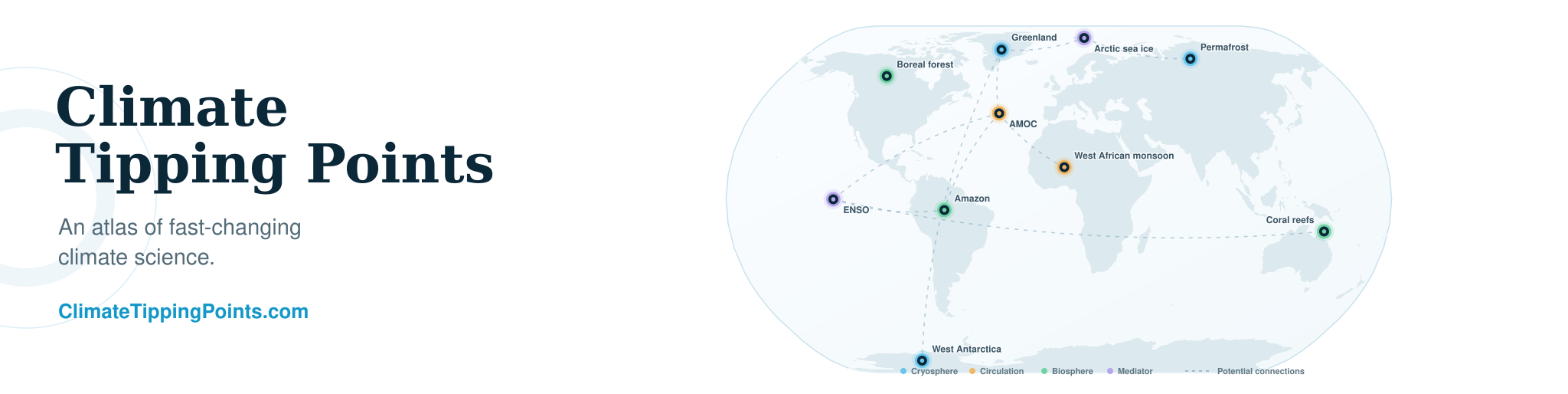
Climate Tipping Points

Visit project

The worst risks associated with global warming are connected to tipping elements: parts of the climate system that could quickly and all but irreversibly enter new states. Tipping elements have the potential to dramatically transform regional environments on human timescales. They could rapidly accelerate global warming. And because many are connected, triggering one could increase the risk of activating another.

ClimateTippingPoints.com provides an easy way to track new research on tipping points: the critical moments when tipping elements in the climate system could move to fundamentally different states. Tipping points are not simple switches that, when activated, change the planet. Nor do they work the same way for every tipping element. Most are poorly understood. Scientists can’t be sure at what level of warming they could occur, or how quickly they could happen, or how exactly they could influence one another.

That’s why this website is needed. It provides a quick overview of the newest research. It’s intended for use by scholars, students, journalists, policy professionals, and anyone who cares about the future of climate change.

Visit project
06

Astronomy journal

AstroJournals

Visit project

My latest book, Ripples on the Cosmic Ocean, emerged out of my work on the history of climate change – but also out of my longstanding hobby, amateur astronomy. Hunched over at least one telescope, I usually spend clear nights outdoors, and my experiences shaped how I understood the histories I uncovered in the book.

AstroJournals.com began as a simple journal of my observations and adventures under the night sky. Presented as diary, its purpose was to help me remember what I saw and experienced with my telescopes. There are many descriptions of cosmic environments – and of the things that kept me from seeing them (foxes, trains, even sudden storms).

As the site’s readership grew, and as I started teaching about the history of space and space science at Georgetown University, my journal entries evolved. I began to explain how the cosmic environments I perceived through my eyepiece helped shape human history. I also offered practical guides to viewing the night sky.

Today, AstroJournals.com is both a record of late night encounters with cosmic environments and an introduction to the profound influence of these environments on human history.

Visit project

Archive

Completed Projects